

In late February this year, I commented on
Sumaiya's post that I wished there was a miniature museum in Singapore. This was what I said: ..
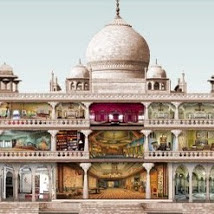
I wish there were more mini museum in Singapore. Sometime back, someone here did a Singapore river scene in the 50s but alas, its gone before I have a chance to see it." As you can tell from the picture above, I found it! In the
Fuk Tak Chi Museum. And it's not the scene of the 50's but the 1800s!
So I trot down there for lunch today, a break between work and spent about 30 minutes snapping away. There is just this one exhibit but the quality more than made up for the quantity!

The
Fuk Tak Chi Museum was a Chinese temple built by Chinese immigrants. It was also the oldest Chinese temple in Singapore. In the museum are close to 2000 exhibits of artifacts which were collected by the residents of Chinatown over many years.
The model however is a recent creation. It is of a row of old shophouses at Telok Ayer Street (1:48 scale?). The real houses have been conserved and are right there outside the museum. Many of them have been converted to restaurants and offices, clubs and watering holes. I work in one of these conserved shophouses at the other side of the river. Can you imagine the mini model was right under my nose all this while?
Front View

Back View

Side View-Right

In the days when Chinese immigrants settled here, Telok Ayer Street ran along the shoreline of a bay that has long since been reclaimed from the sea. The area was where many Hakka and Cantonese immigrants settled as it was also the area where a lot of coolie agents had their offices.
In fact, the Fuk Tak Chi temple also served as the headquarters for the Hakka and Cantonese communities here. In the early days, temples also doubled as welfare associations, a place where disputes were settled and were closely associated with clan associations and development of the community.

"Coolie" is derived from the Chinese word "ku-li "meaning "hard labour". Ku also means "bitter". The coolie's life was thus a hard and bitter one in early Singapore. They came to Singapore, driven by poverty in China to seek a better life here but many, many ended up serving instead as indentured, unskilled labourers.


 "Coolies worked as rickshaw pullers, trishaw riders and farmers. They were employed in mines, ports, in rubber and other plantations, in clearing jungles and on construction sites. They did back-breaking tasks such as loading and unloading cargo and dulang washing or tin ore mining under the scorching sun. It was a common sight in early Singapore to see coolies carrying gunny sacks filled with commodities such as spices and sugar near the Singapore river."
-
National Library, Singapore
 "The majority of the early coolies were indentured to a kongsi, or a "clan association", and their services engaged through a coolie agent or headman. The kongsi was either an organisation, a group or a network of individuals. It acted as a contract or business agency that hired labour in China and supplied them to businesses in Singapore. The kongsi would pay for the passage of the coolies on the condition that the coolies worked for a designated length of time until all expenses incurred were duly paid off. Kongsis usually charged money either from the businesses to which they supplied labour or from the labourers themselves for their service of bringing them into Singapore from China." National Library, Singapore


"Most of the Chinese coolies usually were in different ways coerced and bonded into being coolies for the rest of their lives either before their arrival in China itself or soon after coming to Singapore. The newly arrived coolie recruit was called
sin kheh which meant "new arrival" in Hokkien."-
National Library, Singapore

Coolies were generally very poor and lived in cramped dwellings with hardly any windows or light. These lodgings could be described as "Dickensian" for most lacked water or toilets. Overcrowding was a big problem and coolie lived in cubicle so small some estimated it stood at about 60 sqft per man.


They were given to opium inhaling to relieve their tired bodies of its soreness and to gambling in an attempt to escape from their misery.
 T
he picture below depicts a group of coolies playing "Chap Ji Kee". Some older folks still engaged in this gambling game but it is getting rarer now.

"
The whites and wealthy Chinese employed the coolies mainly because of their willingness to work hard for little money. The coolies were, in a way, the backbone of early Singapore's economy because they generated growth for the economy and caused the country to prosper. Few Chinese coolies went back to China later but most coolies settled down in Singapore doing other odd jobs."-
National Library, Singapore
 Details- Temple Celebration
I heard that in the old days, the image of Goddess of Mercy would be carried around various Cantonese, Hakka and Hainan temples around town . I would imagine the procession of "Mazu" in those days were pretty similar to practices still found in Taiwan nowadays. These processions are boisterous affairs with devotees following the procession with noisy drums and loud horns.


 Details-Wayang
In tandem with a temple celebration is the inevitable staging of a wayang.
A wayang (actually a Malay word) is a Chinese opera, performed in Mandarin or one of the numerous Chinese dialects.(usually Hokkien, Cantonese or Teochew).
 Performed on a make-shift stage, wayangs are typically held in the months of August and September during the Hungry Ghost Festival or during temple celebrations.

I remember these scenes vividly as I have an elder cousin who was crazy about Chinese opera and we would accompany her to watch one of these everytime they staged it. It happened very frequently then and as children, we were excited not because of the opera but because the play we enjoyed, running between the stilts below the stage, eating sticky candy ( I remembered once I had to cut chunks of my hair off thanks to the candy!) and being in the crowd, watching in complete awe and fascination, the actors backstage, preparing..








 Can't keep my eyes open already , see you real soon.


 Can't keep my eyes open already , see you real soon.






 Posts

